1453. The Hundred Years' War was drawing to a close, and peace was returning to the kingdom of France. In the realm ofcivil architecture, this was reflectedin an extraordinary vitality: the last fortified castles soon gave way to more amiable seigneurial residences. Later, thanks to the wars in Italy, these Gothic castles gradually incorporated an antique decor, the sign of an early Renaissance.
In the 15th century, increasingly powerful artillery and the strengthening of central power called into question the usefulness of fortified castles. Many of them were transformed into residential château . This was the case in Nantes, where the Duke of Brittany, François II, undertook major works from 1466 onwards. Defensive posts were sometimes abandoned or transformed into decorative elements, such as ditches that became pleasure gardens, or drawbridges replaced by fixed stone bridges. The trend was to demilitarize castles, which were gradually abandoned in favor of pleasure residences, a trend that became widespread with the Renaissance.
The movement began in Italy with the revolutionary change in the layout of urban stately homes. Hitherto organized as fortified houses, these were transformed into palaces featuring a square courtyard lined with arcades. Specimens were built in Florence (Palazzo Medici between 1446 and 1459). Roman antiquity influenced Italian architects such as Palladio. The modern architecture of the "Quatrocento" was discovered by kings Charles VIII, Louis XII and François I during the Italian wars.
Di Of the individual pictures, Gryffindor, of the panorama, Roland Geider (Ogre) - CC BY 3.0
En ce début de XVI ème siècle, les guerres d’Italie ne provoquent pas une conversion immédiate à l’Art de la Renaissance. Seules quelques personnalités au service du roi comment à s’intéresser à l’art italien (nobles, ecclésiastiques, financiers). Le pouvoir royal de cette époque, Louis XII, y reste assez indifférent. On ne cherche pas à reproduire les bâtiments italiens. Les formes architecturales importées sont insérées et soumise au système de construction gothique préexistant, créant ainsi la synthèse.
Signe des temps, les façades des bâtiments sont monumentales : il y a une volonté d’éblouir et de marquer la puissance nobiliaire retrouvée à cette époque par des emprunts au vocabulaire architectural des édifices religieux. La pérennité d’un appareil militaire, jugé nécessaire pour bien des raisons, dicte l’opposition entre le monde ouvert et aimable de la cour et l’aspect fermé des murs extérieurs.
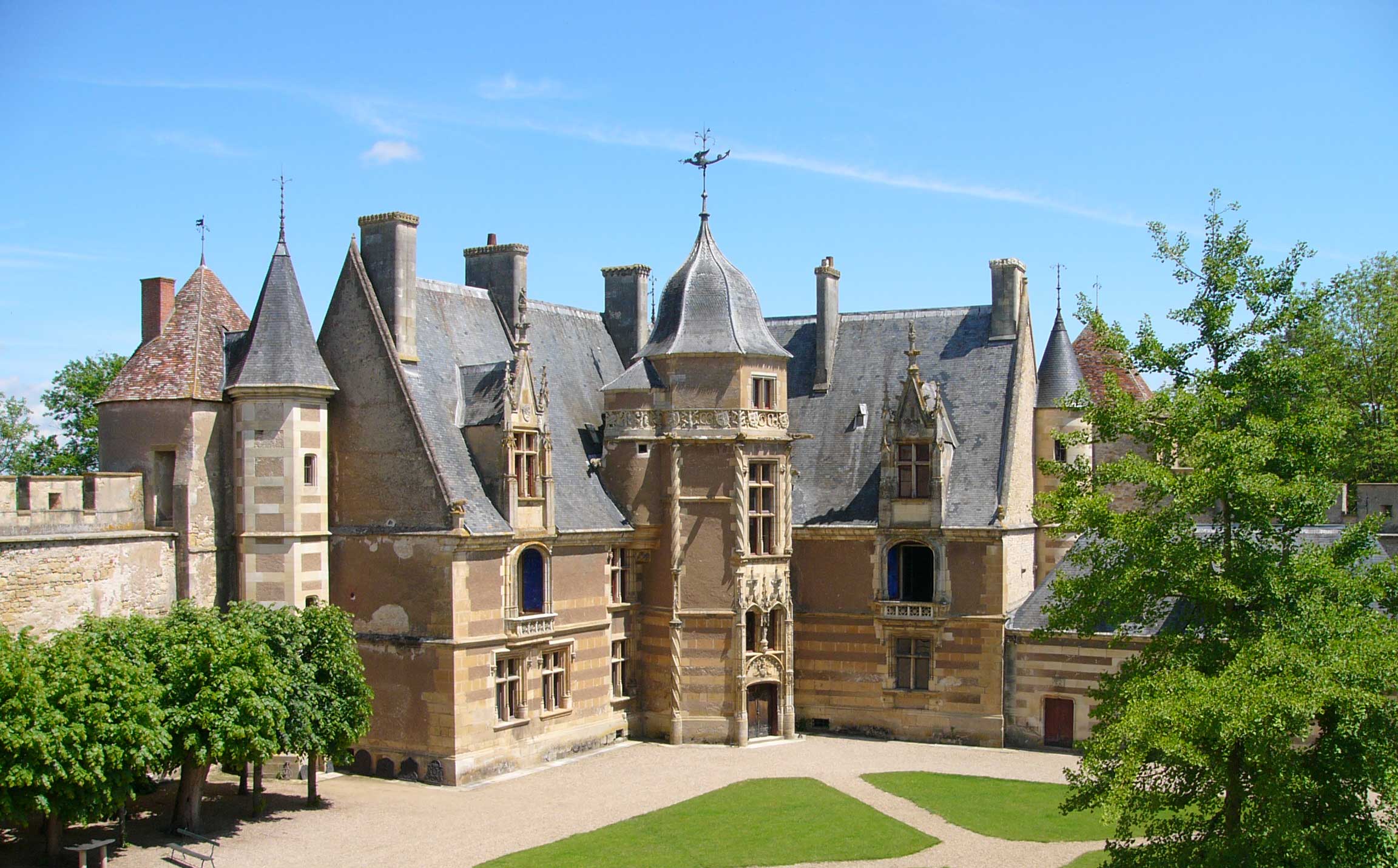
At château d'Ainay le Vieil,architectural changes are reflected in a number of characteristic transformations. The curtain walls lost their military function and a dwelling and apartments were built.
Aesthetic innovations further underline the upheavals to come: slender turrets topped by pepperpot roofs, a monumental spiral staircase with straight banisters replaces the narrow staircase. The staircase is placed in the center of the building and serves apartments on the upper floors, whose rooms are becoming larger. Theloggiaon the Logis facades introduces new notions of comfort, modernity and hygiene.
In contrast to its feudal architecture, the façade of the Logis "Neuf" at château d'Ainay-le-Vieil seeks harmony, balance and the right proportions. For example, the château 's facades are organized in a more regular fashion, with openings superimposed in bays. This new architecture was also characterized by a "three-way" distribution of ornamental elements on the facades: mullioned windows, loggias and dormers. A characteristic that would endure until the end of the Renaissance.
Au sommet de la tour “d’honneur“ on remarque la présence d’un “Tempietto“ (petit temple) qui s’inspire du petit Temple de l’architecte Bramante dans la cour de l’église San Pietro in Montorio à Rome.
En ce début de XVIème siècle le château d’Ainay le Vieil sert en quelque sort de laboratoire d’idées nouvelles en matières d’ornementations, d’embellissements et de décors. L’homme de cour succède à l’homme de guerre, soucieux désormais de considérations esthétique au détriments des considérations défensives.
Jean – Pierre Babelon , « Les châteaux en France au siècle de la Renaissance » , 1989 , Flammarion.
Jean Guillaume , « L’invention de la Renaissance », 2003, Picard.
Jean-Marie Pérouse de Montclos : « Histoire de l’architecture française » , 1989 , Mengès.
Olivier Mignon : « Architecture des châteaux de la Renaissance » , Editions Ouest France.